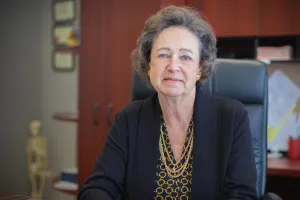
“Some people thought I was a little crazy,” recalls Advanced Practice Nurse Sheryl McDiarmid about a vision she had 35 years ago.
That vision soon became reality and revolutionized the way that we care for patients receiving bone marrow transplants.
And yet it would be only the first of several innovations in patient care that came to define Sheryl’s career at The Ottawa Hospital (TOH).
Watching patients suffer unnecessarily was no longer an option
Soon after Sheryl joined our bone marrow transplant team in 1990, she was deeply affected by an experience caring for a young father. She saw how he suffered through the difficult treatments, and how he was determined to get better and to return to his family. He was in her care for several weeks after his transplant and the prognosis looked good, but tragically he succumbed quickly and unexpectedly.
Sheryl was shattered.
“I walked away thinking ‘I'm going to leave this job.’ But then I went home and I thought, ‘does it really have to be this way?’
“So I had a new vision. Patients were going to come into our treatment unit at TOH and we were going to figure out how to simplify and condense their care. There is nothing worse, more dangerous for patients than complex care,” says Sheryl.
To make this happen, she and her colleagues needed to drill down and figure out how they could provide condensed treatment that would allow patients to go home overnight.
Through unceasing effort, Sheryl and her colleagues succeeded in building and launching what has now become one of the most successful transplant outpatient programs in the world, and the first of its kind.
A true pioneer in nurse-led research
When some physicians questioned the validity of her approach, Sheryl worked with her IT colleague to develop a database and began meticulously logging information. In 2009 she published a paper in The Biology of Blood and Marrow Transplantation based on data from a cohort of 1045 patients. It was the first research paper ever published in that prestigious publication listing a nurse as lead author. Her research demonstrated that patients in the new outpatient program had better outcomes than those who remained in hospital.
Later, Sheryl’s research on the nurse-led vascular access program at TOH was also published in the Canadian Medical Association Journal.
A career filled with patient and care innovations
Sheryl’s dogged determination was a hallmark of her career, as were her commitment to improving patient care, nurse-led research, lifelong learning — and her family
“I earned a Degree in Nursing, a Masters in Education and a Masters in Business Administration, all while working full time and raising children,” she says proudly.
During her career, Sheryl’s commitment to improving patient care led to the creation of several significant programs.
Just this year she succeeded in establishing a Difficult Intravenous Access Program, operating on two of our hospital campuses, seven days a week. This program has a simple but vital mission: to ensure there are always experts who specialize in starting intravenous care on hand so that every patient who needs an IV can have one without delay.
“This is something I have been pushing for my whole career,” Sheryl says. “IV therapy is the foundation of health care — 95 per cent of patients in hospital have an IV. But sometimes it’s really hard to get a line in. Today, patients live longer and they’re sicker. Their skin is often thin and veins aren’t easy to find. We don’t want to be a limiting factor in patients getting their therapy, just because we can’t start the intravenous.
“For years people thought nurses should just be able to do this, but often it requires multiple attempts. In a busy environment it’s hard for nurses to take the time to make something out of nothing. But now we have a team of experts to help.
Once again Sheryl’s determination to improve patient care has yielded valuable results.
“This is the crowning achievement of my career,” she says, “because it’s so foundational to patient care."
Setting a high bar for the definition of “meaningful career”
Sheryl McDiarmid is now retiring after a 50-year nursing career, 45 of those at TOH, having started at the Civic campus in 1976. She isn’t our longest-serving staff-member, but she sure is close!
Her time with us demonstrates how a single career can be defined by the sum of countless powerful ideas, daring innovations, and creative processes that have the power to endure and improve patient care long after we leave our posts.
Now that is a legacy.