

 Print
Print  Share
Share  Text
Text  To reset, hold the Ctrl key, then press 0.
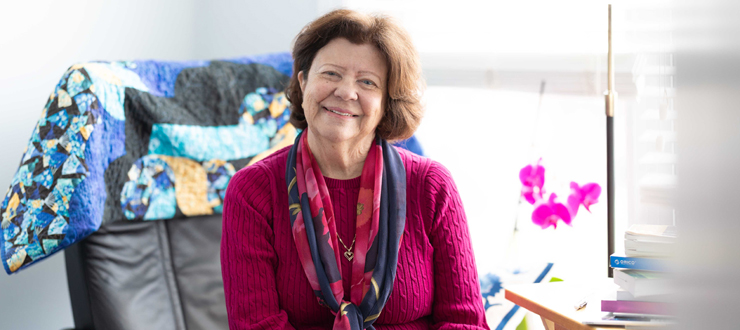
During the past couple of decades, Monica Elaine Campbell could often be found quietly walking the halls of The Ottawa Hospital (TOH). Small in stature, with a twinkle in her eyes, she is a true force for good.
Profoundly deaf since birth, Monica Elaine has been a leading advocate for improving health care for the Deaf community for over 25 years. Her work with our Deaf Patient and Family Advisory Council (PFAC) has positively impacted a great many individual lives, including patients, families and health-care workers at TOH and across the Ottawa region.
Recently, we had a chance to sit down with Monica Elaine, who stepped back from her role leading the Deaf PFAC a few years ago to take full–time care of her husband, who was rapidly declining with Parkinson’s and Lewy Body Dementia. She told us about her journey and the impressive legacy of care she leaves behind.
Speaking and speechreading…the early years
Monica Elaine spent her early life at a school for the deaf in Prince Edward Island learning to speak and speechread, which is the act of interpreting a person’s spoken language by observing the speaker’s lip movements, facial expressions, gestures and body language. In fact, Monica Elaine didn’t even encounter sign language until well into her thirties. With great difficulty, she earned a university degree at the University of PEI and began working in government, relying only on speechreading, textual reading and constant extra study.
Her early oral learning had been enormously difficult and physically exhausting, but after decades of practice, Monica Elaine’s ability to understand speech and to speak aloud has become exceptionally fine-tuned. And yet, her hearing loss is so profound that she has never heard a word in her life, even with a powerful hearing aid.
As a young adult, Monica Elaine remained isolated from other deaf people. It was only later, when she moved to Ottawa and began to learn ASL at the Ottawa Deaf Centre, that she began to gain a new sense of self — a new identity as a member of the Deaf community. It was here that she learned that the culturally Deaf (as opposed to deaf, which is a physical condition) see themselves as a distinct socio-linguistic and cultural group whose main language is American Sign Language (ASL) or Langue des signes quebecoise (Quebec Sign Language). They seek each other out for social interaction and emotional support. Deafness is natural to them; it is a positive identity — NOT a disability.
As she learned more, Monica Elaine no longer felt like a “broken person needing to be fixed,” teetering between the hearing world and Deaf world. Instead, she started identifying herself as a person who happens to have been born deaf and who has various communication needs and skills depending on the circumstances she is in.
Every health-care journey begins with the first patient
Monica Elaine never expected or planned to work in health care. A single fateful encounter in the late 1990s was all it took to open a whole new world.
“One day,” she recalls, “a nurse from The Ottawa Hospital contacted me and asked if I would consider communicating with a patient who was very ill.”
The patient, whose voice box had been removed, was no longer able to communicate with her family by pen and paper due to extreme weakness. She was desperate to continue communicating with them as she approached her final hours. Monica Elaine said yes — she would try to help.
“I had never done communication facilitation before,” explains Monica Elaine. “I put my hand on the patient’s right arm and hand and said, ‘I want to be sure I’m not making mistakes, so what I will offer is: whatever words you mouth, whatever I can understand, I will verbalize. And if I understand correctly, then your family can respond.’”
The patient was very weak. Her lips barely moved. To understand her words, Monica Elaine had to lean in quite close. Yet still she was able to repeat aloud most of what the woman wanted to say.
“I was there for five hours,” recalls Monica Elaine, “and I came away a different person. It really made me think, ‘What if it was me as a patient? What if it was any other Deaf/deaf patient? How would communication work?’”
A resolute commitment to improving care
This experience led Monica Elaine to begin making inquiries among her Deaf/deaf friends in Ottawa about death among the Deaf/deaf, and she discovered that many of them had very sad tales to share. Without the ability to communicate in hospital or hospice, both the quality of care and the patient experience were often horribly compromised for Deaf/deaf patients.
In response, Monica Elaine led nine Deaf colleagues in registering for Palliative Care courses at Algonquin College. Despite initial resistance, she convinced the Dean to accept Deaf people’s registrations and approve the provision of ASL interpreting services for all classes.
This was just the first step in a very long journey, which included countless other obstacles. Yet in the years that followed, Monica Elaine and her colleagues made enormous strides in advancing care for the Deaf. Among many other achievements, Monica Elaine and her valued colleague, Christine Wilson, founded and co-led the Ottawa Deaf Health Care Team in 2009, which led directly to the creation of Canada’s first Deaf PFAC at The Ottawa Hospital in 2019.
Monica Elaine was invested into the Order of Ontario in 2016 for her selfless work to provide palliative care for the Deaf and advocating for the rights of Deaf people to access interpretative services in health-care settings.
Monica Elaine Campbell has left the Deaf PFAC in strong hands, having built a strong foundation of care for the Deaf at TOH. As she steps away, however, it is only right that we celebrate how many lives she has helped to make better, and how much her singular persistence and vision have helped TOH to become a better hospital.
Thank you, Monica Elaine!

Support patient care and research at
The Ottawa Hospital
You might also like…
Living with chronic pain? This online tool offers help — and hope
The Power Over Pain Portal is a free virtual resource hub designed to help empower youth and adults living with chronic pain through education and peer support.

What to do in an emergency: New first aid video series on YouTube
Would you know what to do if you saw someone experience a stroke, heart attack or opioid overdose? We’ve launched a series of easy-to-follow videos on YouTube that walk you through how to respond to common first aid emergencies.

Flu season 101: A quick guide to keeping the sniffles away
Got two minutes? This short guide could help you make it through flu season without stocking up on tissues.
Aging well: Guidance for older adults
In this special video series for both older adults and their loved ones, geriatric care specialists from The Ottawa Hospital offer guidance on navigating common health-care challenges that may arise with aging.
From survivor to supporter: Peer volunteers bring hope to patients recovering from stroke
Drawing on their own lived experiences as stroke survivors or caregivers, volunteers with March of Dimes Canada’s After Stroke Hospital Peer Connections program offer emotional support to those just beginning their recovery journey. Discover the difference they’re making and learn about how you can request support for a loved one — or become a beacon of hope yourself.

How to stay safe around water this summer
Drowning can happen to anyone — even strong swimmers. Emergency physician Dr. Christian Vaillancourt debunks common myths about drowning, explains how to act quickly to save a life, and shares what you can do to keep yourself and your loved ones safe around water.