

 Print
Print  Share
Share  Text
Text  To reset, hold the Ctrl key, then press 0.
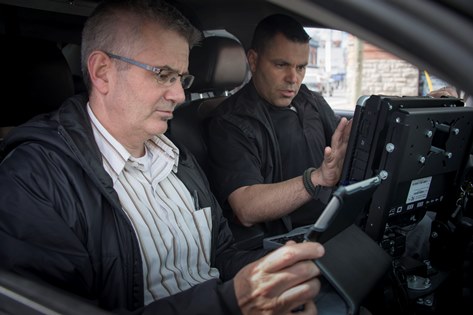
Emergency psychiatrist Dr. Peter Boyles (left) and Const. Stéphane Quesnel trade information so they’re both prepared when they meet potential patients.
The patient initially seemed stable when she opened her front door to emergency psychiatrist Dr. Peter Boyles and three police officers.
But Const. Stéphane Quesnel’s words during the briefing before the visit quickly proved true: the longer patients talk, the more evident it becomes that they need help.
In this case, she claimed people had broken into her home, spied on her, taken away her children and pets, and wanted to burn her at the stake. She also talked about carrying Satan’s baby.
Police officers typically spend 20 percent of their time on people with mental health issues. That’s why having Dr. Boyles (or other members of The Ottawa Hospital’s Mobile Crisis Team) along on weekday afternoon patrols is so helpful. A memorandum of understanding allows the hospital to share patient information with the Ottawa Police Services’ Mental Health Unit and vice versa. That way, Dr. Boyles can help sort out who needs medical help and who is having an “adult temper tantrum.”
“When you know what you’re dealing with you can deal with it more effectively,” said Dr. Boyles. “We see people who would otherwise never see a professional. To me it’s a quality issue.”
On the way to this patient’s home, Quesnel called up police records – scared neighbours have reported she’s been stopping cars, piling garbage in the parking lot and threatening people. She even tried to smoke a crayfish shell. Dr. Boyles called up her medical record on his iPad. She has a diagnosed psychiatric illness but often refuses to go to doctors’ appointments and goes off her meds. He suspected that’s what has happened.
At her home, after Dr. Boyles gave Quesnel a nod, he gently turned her around, put hand cuffs on her, and led her to the unmarked cruiser.
“Now we’re going to expedite everything for her,” Dr. Boyles explained. At the hospital’s Civic Campus, she was led in a back door to the psychiatric emergency section, bypassing the waiting room.
“If a patrol officer did this, you’d have the four-hour wait at the hospital,” said Quesnel. This partnership saves an estimated 918 hours of police time per year, plus avoided visits to the Emergency Department.
Twenty minutes later, Dr. Boyles and Quesnel were back on the road.

Support patient care and research at
The Ottawa Hospital